
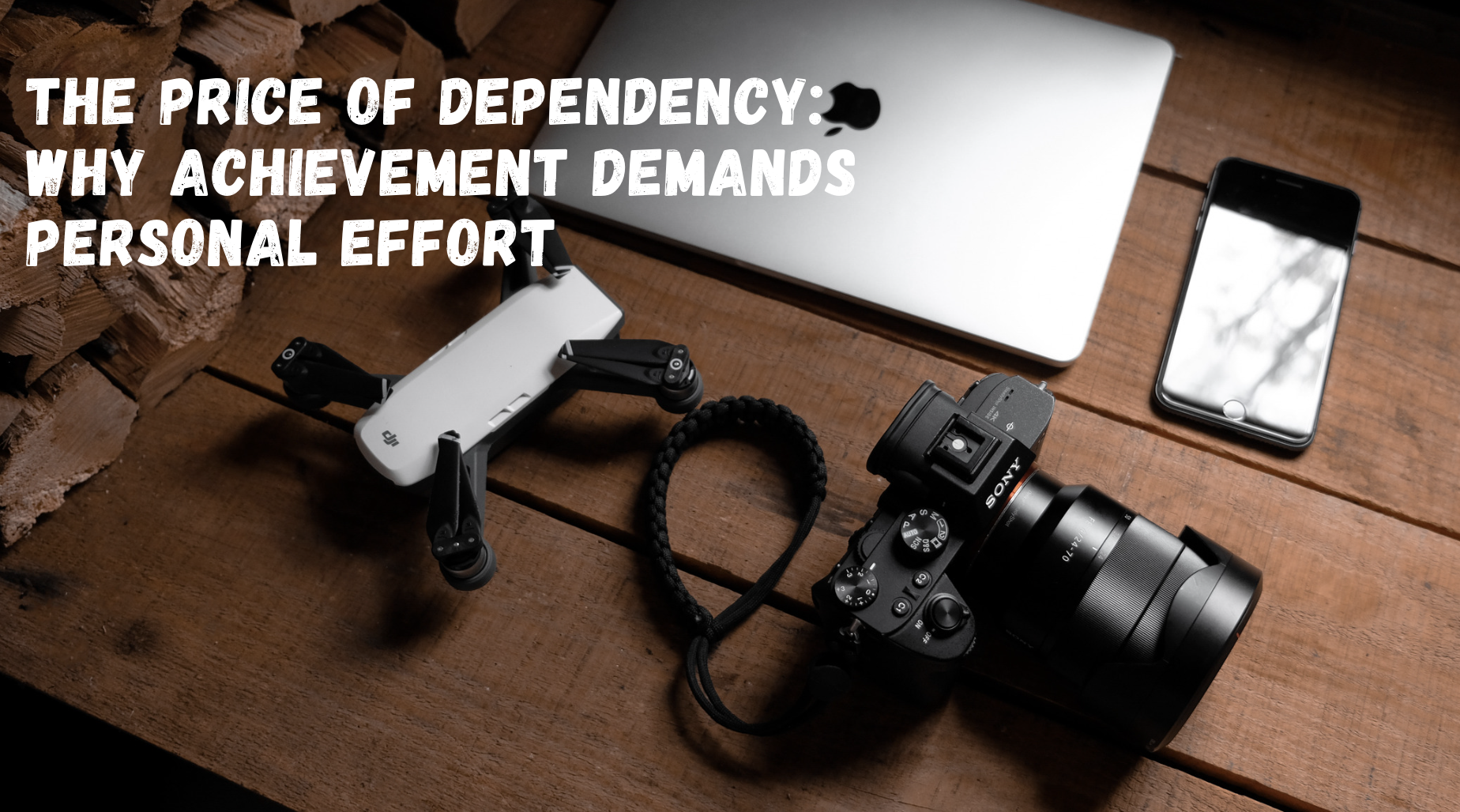
Easy success and instant gratification?
The modern pursuit of so-called “easy successes,” referred to as “quick fixes” or “instant gratification”—represents a social and psychological phenomenon of our time. It is the desire to achieve maximum results with minimal effort and in the shortest possible time.
Many young people strive for quick success because they have grown up in a time where social media presents outward appearances and status symbols as direct rewards for achievement. Young adults equate success with earning a lot of money quickly while wanting to invest less effort than older generations.
“We’ve become so addicted to instant gratification that we’re blind to the impact it has on our lives.”- Frank Sonnenberg
The beggar attitude
Over the last few years. I’ve noticed a specific behavioral shift among young adults. They have grown up in a time when social media presents outward appearances and status symbols as direct rewards for achievement.
During a conversation with a close friend, we noticed a pattern: a rise in what looks like a “beggar attitude”—young people who desperately want luxury items, like the latest gadgets or outfits, but expect to find a benefactor to provide them.
They dream of being creators or entrepreneurs, or of owning tools like the latest gadgets, which represent success.
I remember a time in the West after the war, when economic growth started, and parents had good jobs. They wanted to give their kids everything they had not had in their youth. New toys emerged on the market, but I noticed that kids played with them for only a short time because they did not encourage imagination and creativity.
In Eastern countries, it was not like this. It was only around ten years ago that I remember young friends working alongside their studies to support their families. They were creative and used the internet to learn new skills and pursue their dreams.
Having big dreams is wonderful; it’s the spark of personal growth.

Achievement or Dependency?
In between, this also changed in many ways.
In the time of social media, the strategy for reaching those dreams has completely changed.
We live in an era of instant gratification. You can stream any movie in seconds, order food with a tap, and view the global elite’s lifestyle on an endless social media loop. This creates an illusion that luxury is easily accessible.
Instead of a job application or a savings plan, it’s a search for a benefactor. Whether it is a parent, an older sibling, a boss, or a helpful relative, the question has shifted from “How do I earn that?” to “Who is going to help me get that?”
What used to be viewed as embarrassing has become entirely normalized. It is a shift toward a passive, expectant mindset largely manipulated by the media. But many young adults are unaware of this and are actually losing their sense of pride in their accomplishments.
We live in a time of change, and there is also hope. Because there are also young people who are becoming aware, and I hope this attitude will change.
Self-Dependence as the Key to Lasting Achievement
The truth is, shortcuts are a lie. Bypassing the responsibility and effort to get what they want diminishes their own potential.
Here is why this mindset is becoming the norm and why it is incredibly dangerous.
Social media is like crack-immediately gratifying and hugely addictive. – Gary Vaynerchuck
1. The lack of the Feeling of Accomplishment
We live in an era of instant gratification. You can stream any movie in seconds, order food with a tap, and view the global elite’s lifestyle on an endless social media loop. This creates an illusion that luxury is easily accessible.
When you don’t work for an object, the object carries zero emotional weight. Also, the goals switch quickly. One week it’s an iPhone; the next week it’s maybe the newest fancy dress. Because no personal labor or sacrifice was invested, the item loses its value the second it is acquired, as there is no pride in owning it.
2. Acting independently
There is a dependency that young adults completely overlook. When you buy a piece of technology with money you earned from a job, that device represents your competence. It is yours.
But by manipulating someone else into bridging the financial gap, you give away a piece of your independence. You have lost your independence. And you lose self-esteem.
3. Confusing Survival with Status
The global economy is tough, and housing and living are costly. It is easy to forget what is really necessary, and the latest gadgets or trendy clothing are luxuries. When young adults feel not good enough because they can’t afford high-end goods, they forget the concept of hard work. A person must realize a luxury lifestyle can only come from the value of his work.
The Real Way to Reach Your Dreams
Building Competence over Consumerism
The most confident, secure young adults are the ones who know how to solve problems and earn a living. They take responsibility for their lives and have developed character, resilience, and skills that are needed and valuable, not the ones who carry the newest gadgets.
Don’t trade your long-term potential for short-term external validation.
Ask for a hammer. Step out into the world, get a job, save the money, and build your own foundation. The pride of looking at something you built completely on your own is worth infinitely more than any shiny object.
See also one of my favorite poems > A Poem About Hard Work – Toil And Treasure
You have the wings to fly—stop waiting for someone to carry you.

The story of the two falcon chicks is a good analogy for this subject.
The Tale of the Two Falcon Chicks
“I was reading an old fable the other day about a falconer who raised two chicks.
The first chick was aggressive. Every time the falconer came near, it would fight, snatch the meat, and try to tear itself away from the leash. It was difficult to deal with, but it desperately wanted to fly.
The second chick was incredibly polite and ‘smart.’ It figured out that if it just chirped sweetly, sat perfectly still, and looked pathetic, the falconer would hand-feed it the best prime cuts of meat without it ever having to flap a wing. It considered itself far more intelligent than the other hawk. It looked at the first chick struggling on the leash and thought, ‘What a fool. Look how hard he is working for what I get for free.’
A year later, the falconer opened both cages. The first hawk soared rapidly into the sky; it flew toward the mountain peaks and found the prey it needed—it was completely free.
The second falcon hopped out of the cage, sat on a rock, and starved to death within three days because its wings were completely useless. Although it lived under the belief that it was more intelligent than others, the reality was that it had lost the capacity to use its own wings.
“You were born with wings; why, then, do you choose to crawl through life?” — Rumi
See also How To Be Successful By Taking Responsibility For Your Life
And Whatever We Set Our Mind To We Sure Can Achieve







Leave A Comment